Here’s How Bobbie & Thrive Market Are Supporting Parents This NICU Awareness Month
Publish Date: September 1, 2026
Last Update: September 1, 2026
Since its inception in 2018, Bobbie’s mission has never just been about selling baby formula. “We’ve been working at a policy level for the entire time that Bobbie has existed,” says Michele Lampach, Bobbie’s Director of Impact. The recognizable green cans of organic, European-style formula have secured Bobbie a spot on nearly every list of modern parenting must-haves—but behind the scenes, it’s the team’s advocacy work that is the real heart of the brand.
In 2020, when the team learned that the Affordable Care Act didn’t cover donor milk or infant formula for mothers with breast and gynecologic cancer, they set out to partner with The Breasties to support parents who medically cannot breastfeed, with a year of infant formula—with a promise to push for systemic change along the way.
Since then, Bobbie for Change and The Breasties co-created Connie’s Bill, which would create a pilot to cover donor milk and infant formula for parents impacted by medical necessity. And in the six years of their partnership, Bobbie has supported more than 600 families affected by breast and gynecological cancers, donating more than 200,000 cans to these and other families in need.
Bobbie for Change, the brand’s advocacy and impact arm, officially formed in 2023—allowing this work to not only continue, but to expand and grow. Its four pillars of focus are: supporting infant nutrition, eradicating maternal mortality, rapid response (enabling the team to respond quickly in times of natural disasters or crises), and paid family and medical leave. “We believe that one way we can evolve society for modern parenthood is by making sure that parents, both birthing and non-birthing, have time to bond with their babies, extend their breastfeeding journeys, and recover from birth,” Lampach says. With this in mind, they’ve petitioned lawmakers to demand paid family and medical leave for all Americans.
“Our heartbeat is feeding babies,” Lampach says. “We’re really rooted in that because all of these issues are nonpartisan. No matter what side of the aisle you’re on, being able to feed your baby, having access to paid leave—these are things that are human rights.”
Honoring NICU Families During NICU Awareness Month
Supporting families with babies in the neonatal intensive care unit (NICU) is a natural extension of the work Bobbie was already doing internally, with their employee base of majority parents. “When a mom on our team went into labor nearly three months early, we launched our NICU leave policy overnight to meet her in her reality,” , ” Lampach recalls. “For every week a Bobbie team member has a baby in the NICU, we add a week to their paid leave policy, up to 16 weeks, so they’re able to spend the time bonding with their baby once they are home safely, without eating up their entire paid leave time.”.
Bobbie prides itself on starting with internal policies, and then moving externally via Bobbie for Change, to extend impact beyond the virtual walls of the company.
Last year, Bobbie galvanized our Colorado customers to support grassroots organizations there to passs NICU-specific leave coverage, one of the first policies of its kind at a state level. “[It requires that] if a baby is in the NICU, the parent gets additional coverage on top of their regular paid leave,” Lampach says.
September is NICU Awareness Month. It’s a time to honor families with a child in the NICU, to celebrate NICU graduates, and to recognize the dedicated healthcare professionals who care for critically ill and premature infants. It’s also a time for NICU families to share their stories and connect with others who may be facing similar challenges.
To help further the incredible work that the team at Bobbie has already been doing, we jumped in to help support a family whose baby recently left the NICU—healthy, happy, and well fed thanks to Bobbie.
Meet Kaylie and Coleson: A First-Time Mom and Her NICU Graduate Baby
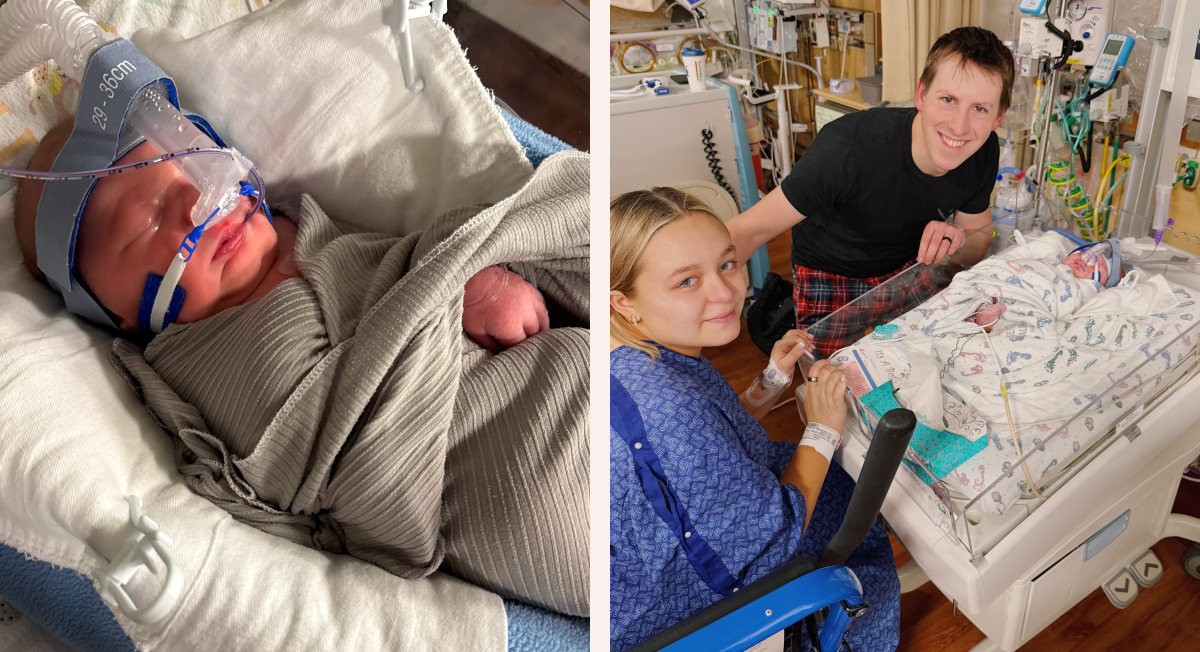
One night in March, around 3 a.m., first-time mom Kaylie’s water broke. She was going into labor. At the hospital she developed a fever, and her son Coleson immediately needed a round of antibiotics. “At that point, I knew there was a possibility he would have to go to the NICU,” she says.
Kaylie’s intuition was right: as soon as he was delivered, Coleson was taken straight to the NICU. “I didn’t get to hold him, and as a first-time mom, it was absolutely terrifying,” she remembers.
She describes those first few hours as “anything but natural”. Because of Coleson’s fragile state, she was soon told that exclusively breastfeeding could mean that he would go home slower than if they were to supplement with formula. “It was one of the most defeating feelings I have ever experienced,” she says.
The family spent a little over two weeks in the NICU. Coleson was still struggling to eat and breathe on his own, though Kaylie’s days revolved around feeding, pumping, and trying to get him up to a healthy weight. “I was alone in the NICU for most of the experience, because my husband did not get a single day off from work,” she says. “Every time I had to leave the hospital to go home and rest, it felt impossible. My husband would come at night, and every time we left the hospital, I would sob in the elevator and then cry again in the parking lot.”
Finally, after weeks of round-the-clock feeds and constant worry, Coleson started to turn a corner.
“I vividly remember the moment I saw him without his CPAP for the first time,” Kaylie says. “I finally got to see his whole face. I got to hold him without wires attached to him, and for the first time, I did not have to ask to hold or feed my own baby.”
After the most “physically exhausting and emotionally draining” weeks of their lives, Kaylie and her family were finally able to go home.
A Feeding Journey
When Coleson had been home from the NICU for about three months, he still only weighed ten pounds. He had developed severe acid reflux and was throwing up most of his feeds.
“I remember standing in the formula aisle completely confused,” Kaylie says. There were so many options, so many different labels, and Kaylie had no idea what was going to work for Coleson’s needs—and she received little advice from her pediatrician. “After everything we had already experienced in the NICU, I never imagined that those struggles would continue once we were home,” she says. “A few months into his life, I was still desperately trying to figure out how to help my baby.”
That’s what led the family to Bobbie.
“Bobbie has become such an important part of our little family’s journey,” Kaylie says.
Now, five months after their traumatic birth experience, Kaylie is grateful for every smile Coleson gives her. “Happy crying is something I never really experienced before becoming a mom, but now I find myself doing it all the time,” she says. “After everything we went through in the NICU, getting to watch him grow up healthy and happy feels like the greatest gift.”
Supporting Kaylie, Coleson, and Other NICU Families
“Our NICU journey was not the beginning of motherhood I imagined, but it became a chapter that changed me forever,” Kaylie says today.
Currently, about 1 in 10 babies will end up in the NICU after they’re born. The leading causes of NICU stays are premature birth, low birth weight, or medical issues such as infections or breathing trouble. Parents like Kaylie are often forced to stay at the hospital during their baby’s time in the NICU, requiring them to miss work, find childcare for other children, and in many cases, worry about the significant medical expenses.
It’s an incredibly stressful situation for all involved, and we were eager to find a way to take away some of the burden for Kaylie’s family.
Through our partnership with Bobbie, we’re able to support Kaylie, Coleson, and their family with essential groceries and supplies to help them get back on their feet following their NICU experience. While Bobbie is now supporting the family with a supply of formula for Coleson, we are also providing them with a one-year Thrive Market membership and a $500 gift card to help stock their pantry with healthy, wholesome foods and household essentials.
When asked about the advice she’d give to other NICU parents, Kaylie says that most importantly, she wants them to know that they’re not alone. “There will be days when you feel completely exhausted,” she says. “There may be days when you wonder if you are doing enough. You are. Even when you feel helpless, your baby knows you’re there.”
She also stresses the importance of celebrating the small victories along the way, which was a mindset shift that helped her make it through her own NICU journey. “A completed bottle, a better oxygen level, fewer wires, a successful feeding—these moments may seem small to someone who has never experienced the NICU, but you will learn that they are everything.”