How to Recycle (Almost) Anything: The Thrive Market Guide
Publish Date: June 30, 2026
Last Update: June 30, 2026
This article was reviewed for accuracy by Michelle Leonetti, QA Nutrition & Regulatory Manager, Alex Gusmer, Brand & Packaging Manager, and Sabrina Wildermuth, Director of Nutrition & Regulatory Compliance.
There’s a specific kind of anxiety that lives next to the kitchen recycling bin. You’re holding a yogurt cup, or a greasy takeout box, or a tangle of bubble wrap, and you genuinely don’t know what to do with it. So you do what most of us do: You toss it in, hope for the best, and try not to think about it too hard.
Here’s the truth that gets lost in all the conflicting advice: While not everything can be recycled, for the things that can, you just need to understand how to get them to the right place!
Why Recycling Feels So Confusing
Recycling rules are different everywhere. A container that’s accepted curbside in one town is landfill-bound in the next, because every local program runs on different equipment, different contracts, and different markets for the materials they collect.
In order to ensure that your recycling is actually recycled, you just have to learn the patterns that hold almost everywhere, then familiarize yourself with your local guidelines.
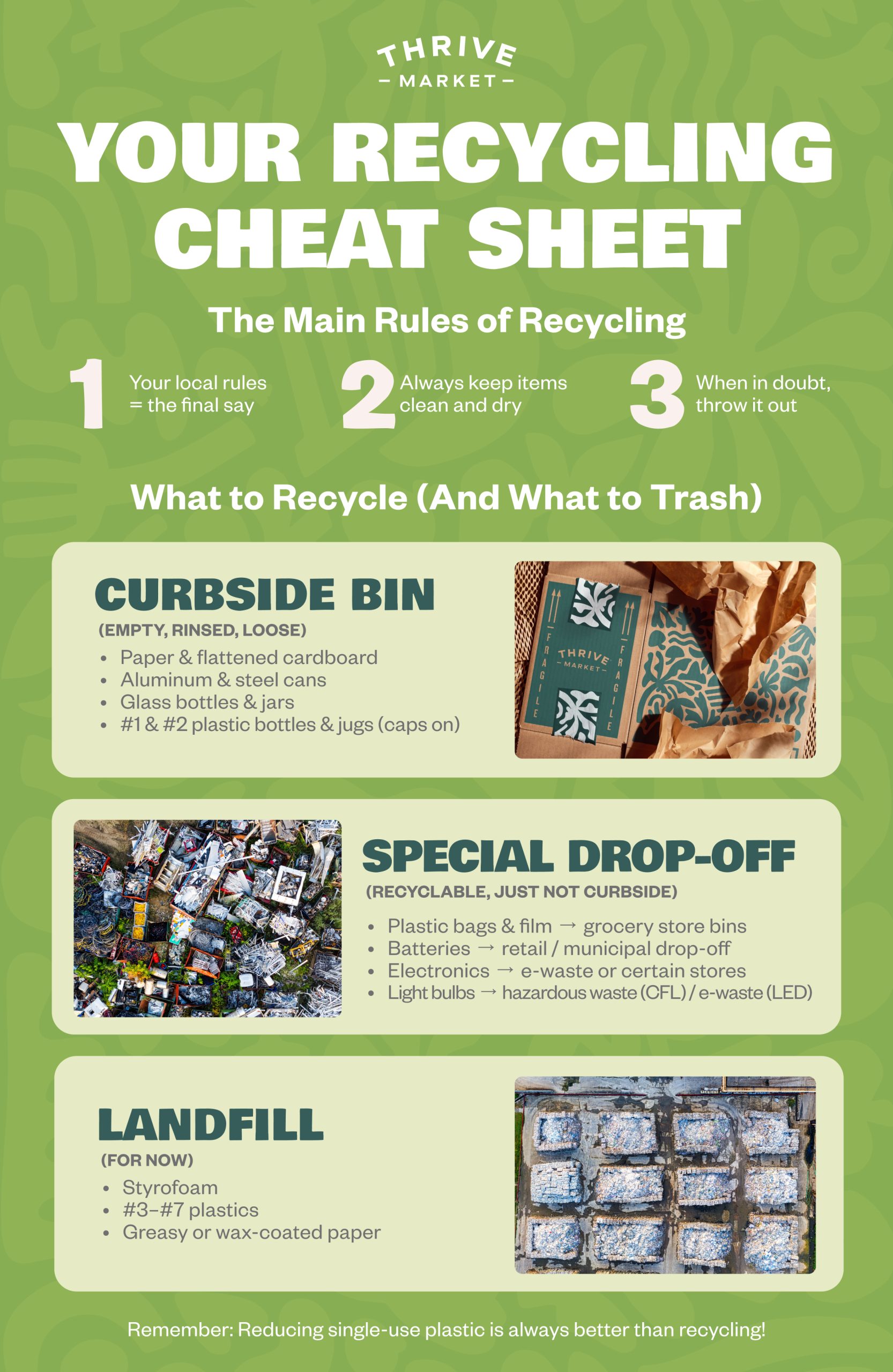
The Three Golden Rules of Recycling
1. Your town has the final say. This is the rule that makes all the others work. Your local waste or recycling authority publishes exactly what they accept, and they’re usually one quick search away.
2. Make sure all containers are clean and dry. Food residue should be avoided at all costs in the recycling bin. A jar with peanut butter crusted inside, a can half-full of soda, a sauce-soaked container—these don’t just fail to recycle, they can contaminate everything around them. You don’t have to wash all your recycling containers in the dishwasher, but a nice, thorough rinse is always helpful before adding it to the bin (just be mindful of water use!)
3. When in doubt, throw it out. This one feels backwards, especially if you care about doing the right thing. But something known as “wishcycling”—tossing something in because you wish it were recyclable—is one of the biggest problems facilities face. However, a single plastic bag can tangle the sorting machines. A greasy container can spoil a batch of clean paper. When you’re genuinely unsure and can’t quickly check, the trash is the responsible choice.
Recycling vs. Trash: How To Understand What Can Be Recycled (and What Can’t)
Here’s What to Put in the Curbside Recycling Bin
In most curbside recycling programs, these can confidently go in the bin—just make sure they’re empty, rinsed, and loose (never tied up in a trash bag):
- Paper and cardboard. Flatten your boxes so they don’t take up space, and keep everything dry. Office paper, newspaper, magazines, mail, and clean cardboard are all reliable winners. Skip anything wax-coated, laminated, or greasy.
- Metal cans. Aluminum and steel (sometimes called “tin”) cans are both highly recyclable, and aluminum especially is a star—it can be melted down and back on a shelf as a new can remarkably fast, using a fraction of the energy it took to make the first one. Just rinse them out and place them in the bin.
- Glass bottles and jars. Most recycling programs advise leaving metal lids on or recycling metal lids separately if your program asks. (One note: A growing number of towns have pulled glass from curbside collection because it breaks and contaminates other materials, routing it to drop-off centers instead. If you’re not sure if your town accepts glass, it’s worth a quick check.)
- Plastic bottles and jugs (#1 and #2). These are things like water and soda bottles, milk jugs, detergent, and shampoo bottles. Modern guidance is to leave the caps on; facilities prefer it, and loose caps are too small to sort.
Here’s What You Can Recycle—Just Not Curbside
Here’s where a lot of “wishcycling” goes wrong. These items genuinely can be recycled, but tossing them in your home bin does more harm than good. They each have their own specific recycling facility, and getting them there may require a bit more effort.
- Plastic bags, film, and wrap. This includes grocery bags, bread bags, the plastic around a case of water, and most bubble wrap and air pillows. They jam sorting machinery, so they can never go in the curbside bin. Instead, bundle them together and drop them in the film-recycling bins you’ll find at the entrance of some grocery and big-box stores.
- Batteries. Never put these in any household bin. Rechargeable and lithium-ion batteries (the kind in phones, laptops, and power tools) are a serious fire risk in collection trucks and have caused real facility fires. Take all batteries to a designated retail or municipal drop-off. (Tip: Many hardware and electronics stores have collection boxes right by the door.)
- Electronics (“e-waste”). Old phones, cables, chargers, routers, and gadgets contain valuable metals worth recovering—and sometimes hazardous components worth keeping out of the landfill. Look for an e-waste drop-off event, a permanent collection site, or a manufacturer/retailer take-back program.
- Light bulbs. These need sorting by type. Compact fluorescents (CFLs) contain a small amount of mercury and must go to hazardous-waste handling. LEDs are best sent to e-waste or specialty recyclers. Old-school incandescents aren’t recyclable and go in the trash.
Here’s What You Can’t Recycle
Some things just don’t have a good recycling path right now, and pretending otherwise doesn’t help anyone.
- Styrofoam. Those clamshell containers and packing blocks are almost never accepted. A handful of specialty drop-offs exist, but for most areas, they have to go in the trash.
- Plastics #3 through #7. These include a lot of plastic utensils and mixed-material packaging. “Compostable” plastics are also included in this category, unless you’re able to put them in a compost bin.
- Mixed-material items like lined paper coffee cups, foil-lined wrappers, and many snack pouches are built from layers that can’t be separated, which makes them effectively unrecyclable.
Instead of feeling guilty for not being able to recycle certain items, it’s better to build awareness. When something has no good end-of-life path, the real solution lives further up the chain: buying less of it, or best of all, choosing a reusable version to avoid single-use materials altogether.
Decode the Label: What “How2Recycle” Means
If you’ve noticed a small black-and-white label on packaging that actually tells you what to do—a little bin icon with words like “Store Drop-Off” or “Widely Recyclable”—that’s How2Recycle. It’s a standardized labeling system from the nonprofit GreenBlue’s Sustainable Packaging Coalition, and it exists to replace the confusing little number-in-a-triangle codes, which only identify what a plastic is made of and say nothing about whether you can actually recycle it.
How2Recycle rates each component of a package separately (the box, the liner, the bag), and sorts each into one of four categories based on how many people can actually recycle it:
- Widely Recyclable. At least 60% of households can recycle it through curbside or drop-off. Put it in your bin.
- Check Locally. Only some households have access, so it depends on your town. Confirm with your local program.
- Store Drop-Off. Bring it to a retail collection bin (the plastic-film bins at the front of some grocery stores). This applies to flexible plastic films and is a U.S.-only designation.
- Not Yet Recyclable. Fewer than 20% of households can recycle it, or it can’t be processed reliably. This one goes in the trash, which keeps non-recyclables out of facilities so they don’t contaminate the good stuff.
When a package has a How2Recycle label, trust it over the plastic number—it reflects what real facilities can actually handle, not just what the plastic is technically made of. You may also spot a newer “How2Recycle Plus” label with a QR code: scan it, enter your ZIP code, and it gives you recycling guidance specific to where you live.
Most of the products within Thrive Market brands (f.a.e. by Thrive Market, wellmade by Thrive Market, Rosey by Thrive Market, and Thrive Market Goods) contain a How2Recycle label to help you discern how to recycle them. For example, you’ll find this label on the plastic bottle of our Laundry Wrinkle Releaser; the glass spray bottle of our Propolis Throat Spray; and the glass jar of our Organic Capers.
To shop only recyclable products at Thrive Market, become a member and shop using our “Recyclable” shopping filter.
What About Your Thrive Market Box?
When you shop with Thrive Market, your order shows up in packaging we designed to land mostly in your curbside bin—and that is made from materials that already had a first life. Here’s exactly what arrives and where it goes:
- Shipping box and tape. Curbside recyclable, made from 30-50% recycled content. The tape goes in right along with the box; no need to peel it off.
- Interior box dividers. Curbside recyclable, made from 100% recycled content.
- Insulated liners (a.k.a. the padded sheets that keep cold items cold). Curbside recyclable, made from 97% recycled content.
- Void fill (a.k.a. the crinkle paper). Curbside recyclable, made from 100% recycled content.
- Plastic bags (the resealable ones around fragile and liquid items). These are #4 plastic, food-grade, and made from up to 30% recycled content. Skip the curbside bin; take them to a store drop-off, or better yet, reuse them.
- Insulated bags. Made from up to 30% recycled content; drop-off recyclable, so check your local rules.
- Gel ice packs. The gel inside is biodegradable and food-safe, so you can pour it down the drain or dilute it as a nitrogen plant food (check that your plant likes nitrogen first). The plastic film around it is a #4 drop-off recyclable.
A few other things we do before the box ever reaches you: We aim to fit 12-14 items in each one so we’re using space efficiently, everything travels by ground rather than by plane (which uses about 84% less CO2), and we’ve been carbon neutral since 2014—including fulfillment centers powered by renewable energy.
And because the best packaging is the kind that gets a second life, plenty of it is worth keeping.
- Boxes flatten down for storage and moving (or become a very respectable kid-built pirate ship).
- The resealable bags are handy for storing fresh herbs, corralling junk-drawer clutter, freezing leftovers, or packing snacks to go.
- Even the crinkle paper and corrugated cardboard can be torn up and added to a compost pile as a carbon layer or used as wrapping paper for birthdays or holidays.
Want to learn more about our sustainable packaging? Check out our complete guide (and if you like the looks of our boxes, you might want to order your own by becoming a Thrive Market member!)
Recycling FAQs
Do I need to remove labels and tape? Most of the time, no. Facilities are built to handle paper labels and a bit of tape. Just empty and rinse—don’t make it a project.
Caps on or off? For most plastic bottles and jugs, keep the caps on. Loose caps are too small to sort and often end up as litter.
Is the pizza box recyclable? The clean parts (like the lid) usually are. Tear off and trash any sections soaked with grease or stuck-on cheese.
Can I bag my recyclables to keep them tidy? No—keep everything loose in the bin. Bagged recyclables often get sent straight to the landfill because workers can’t safely open them.
What do those numbers inside the recycling symbol mean? They identify the type of plastic, not whether it’s recyclable. #1 (PET) and #2 (HDPE) are the most widely accepted; #3 through #7 usually aren’t taken curbside. When in doubt, the number plus your local list is the real answer.
Do I have to rinse something if it only held dry food? Usually not. A cracker box or a clean peanut tin can go straight in. The rinse rule is really about sticky, greasy, or wet residue that can contaminate other materials.
Is shredded paper recyclable? Often not curbside—the fibers are too short and small to sort, and loose shreds blow around facilities. Some programs accept it bagged at a drop-off, and it’s also great in compost. Check your local rules.
Are aerosol cans recyclable? Often yes, if fully empty—many programs take empty steel and aluminum aerosol cans curbside. If there’s product left inside, it’s treated as hazardous waste. Check your local guidance.
Can I recycle glass that isn’t a bottle or jar? No. Drinking glasses, ceramics, mirrors, and window glass are made differently and melt at different temperatures, so they contaminate container-glass recycling. Keep those out of the bin.
Are receipts recyclable? Most aren’t. Many are printed on thermal paper coated with chemicals that can’t be recycled and shouldn’t be composted.
Can I recycle the plastic bags around my Thrive Market liquids? Not curbside—they’re #4 plastic and will jam sorting machines. Take them to a store film-drop-off bin, or reuse them (they’re food-grade and resealable). Same goes for the insulated bags.
The insulated liner in my frozen Thrive Market order—trash or recycling? Curbside recycling. Our insulated liners are made from 97% recycled content and are curbside recyclable, so they go right in with the box and crinkle paper.
What do I do with the gel ice pack in my Thrive Market order? The gel is biodegradable and food-safe—pour it down the drain, or dilute it as a nitrogen plant food (check that your plant likes nitrogen first). Then recycle the outer plastic film with #4 drop-off plastics.
Do the plastic windows on boxes and envelopes need to come off? Usually not. For window envelopes and boxes with a small clear panel (think pasta boxes or bakery boxes), you can recycle the whole thing in your paper or curbside bin—the mill pulps the paper and screens out the little bit of film. A good rule of thumb: The bigger the plastic relative to the cardboard, the more it’s worth tearing the window out first and trashing it.